

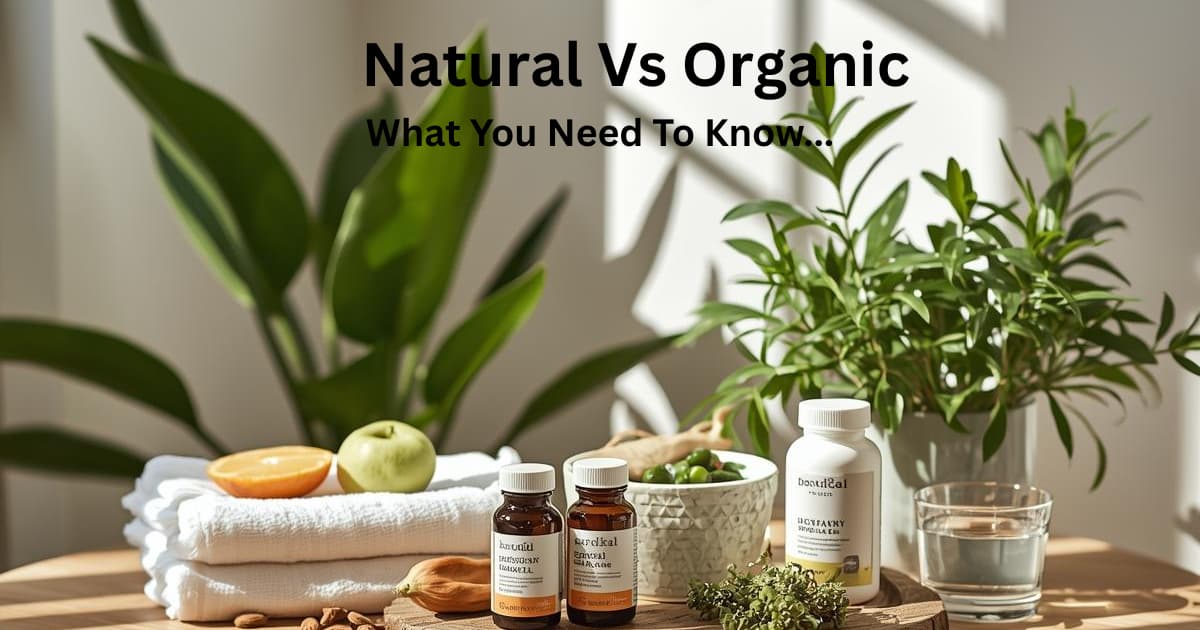
What shoppers must understand before trusting what’s on the front of the bottle.
Why Organic and Natural Products Can Be So Confusing in Big-Box Stores.
When you stroll down the grocery aisle, you’ve likely seen products labeled as “natural” and “organic.” But what do these labels really mean? Here’s a closer look at the differences and what you should keep in mind when shopping.
Organic is a regulated certification. Natural is a quality spectrum.
And both can be excellent or misleading, depending on the brand.
This guide will teach you how to read labels the right way, avoid greenwashing and choose products based on science, safety and transparency not buzzwords.
1. What Does Organic or Natural Actually Mean on Labels?
Organic (USDA Regulated):
In the United States, “Organic” is a legal certification governed by the USDA.
To use the USDA Organic seal, a product must meet strict requirements, including:
- No synthetic pesticides or herbicides
- No GMOs
- Approved soil and farming practices
- Controlled processing standards
- Annual third-party inspections
Organic certification focuses primarily on how ingredients are grown.
Natural (Not Legally Defined):
“Natural” simply means ingredients are derived from natural sources such as plants, minerals, or biological materials. It does not automatically regulate:
- Heavy metal contamination
- Microbial purity
- Finished-product potency
- Manufacturing facility quality
- Third-party lab verificatWhich means natural product quality depends entirely on the brand.
2. Are Natural and Organic Regulated Labels?
- Natural: No federal legal definition in the U.S.
This does not make natural inferior, it simply means quality must be verified through testing, not labels.
3. Is Natural the Same as Organic?
No.
They overlap but they are not the same.
| Organic | Natural |
| Farming-regulated | Source-based |
| USDA certified | Brand-dependent |
| Controls soil & pesticides | Controls origin, not purity |
| May lack potency testing | May exceed organic in purity testing |
4. Are Naturals and Organics the Same?
They can overlap, but they are not identical.
Many high end supplement brands intentionally remain “natural” because organic certification does not cover:
- Finished product purity
- Potency verification
- Heavy metal screening
- Microbial contamination
- Manufacturing quality
These brands instead invest in third-party lab testing and FDA-registered facilities, which directly protect your health.
5. Is 100% the Same as Organic?
No.
“100% natural” is not a regulated certification in the U.S. and does not guarantee:
- Pesticide-free crops
- Clean soil
- Solvent-free extraction
- Purity testing
- GMP manufacturing
It only means the ingredients are derived from natural sources.
6. Is Organic Healthier Than Natural?
Sometimes, but not always.
Organic controls how ingredients are grown.
Natural quality controls how the product is purified, tested and manufactured.
A natural product that is:
- Third-party lab tested
- Heavy metal screened
- GMP manufactured
- Potency standardized
can be safer and more effective than a minimally tested organic product.
7. Does Natural or Organic Always Mean Healthier?
No.
Health depends on:
- Testing
- Transparency
- Purity
- Dosage accuracy
- Manufacturing standards
A poorly tested organic product can be riskier than a rigorously tested natural product.
8. Natural vs Organic Ingredients: Which Matters More?
Both matter, but testing and manufacturing matter more than farming alone.
Best products use:
- Clean natural ingredients
- Organic where possible
- Third-party purity verification
- FDA-registered manufacturing
9. Why Are Natural and Organic Search Terms Usually Synonymous?
Because marketing trained consumers to associate both with “healthy.”
However, only one is legally regulated.
Smart consumers look beyond search terms and shop by proof, not slogans.
Natural and Organic Products for the House and Home.
This applies to:
- Cleaners
- Laundry detergents
- Candles
- Skincare
- Soaps
- Air sprays , the list is endless, from the moment we wake up to the time we put our heads on that pillow we’re forever using these products, right?
Well, look for:
- Ingredient transparency
- Third-party testing
- No synthetic fragrance
- No endocrine disruptors
- Sustainable packaging
Why I Recommend Certain Natural Products (Quality-First Disclaimer):
I recommend only brands that:
- Manufacture in FDA-registered facilities
- Follow GMP standards
- Provide third-party lab results
- Screen for heavy metals and microbes
- Are fully transparent
These standards often exceed organic requirements for real-world safety.
Expert Favorites; 5 Natural Alternatives That Don’t Compromise On Quality.
- Man Greens – Natural Testosterone Support
- Hydrate from Tru Wild – Natural electrolyte mix without artificial sweeteners
- Septifix – Natural bacteria boost for septic systems
- AquaPeace – Natural hearing support formula
- Pep Tonic – Natural metabolism booster, jitter-free energy supplement
Here’s Your Take In All This…
Navigating the aisles of major retailers can be overwhelming, but the takeaway is simple: “Organic” is a helpful farming standard, but “Natural” is where some of the most innovative, high-performance products live today.
When choosing what to put in or on your body or even how to maintain your home, the USDA seal shouldn’t be your only filter, though it’s a great start.
Consider also:
- Transparency
- Testing
- Facility quality
- Ingredient sourcing
- Brand integrity
The cleanest choice is a transparent, tested product…organic or natural.
That is how you protect your health.
Disclaimer:
This website uses affiliate links, this means that If you purchase through these links I may earn a commission at no extra cost to you. This helps support our work and allows us to continue providing valuable content. Please note we do not intend to replace any medical advice ref to the product(s) on this website, unless stated otherwise.
The information provided here adheres strictly to the products’ official guidelines and not intended to diagnose, treat, cure or prevent any disease(‘s) therefore it should not replace professional medical advice issued by your licensed healthcare providers.
Kindly note that if you are taking medication or suspect you have a medical condition, please consult your physician before using these products. All claims are based solely on the official product descriptions & individual results vary depending on several factors based on the individual using these products. We will not make unsubstantiated claims or use terms like “guaranteed results” on this website.